Architecture
Exphere’s current workspace provides documentation, separate CLI/SDK packages, and a bounded local runtime lifecycle implementation. Live infrastructure execution remains operationally unverified. The diagrams below describe the broader proposed platform.
Context to execution
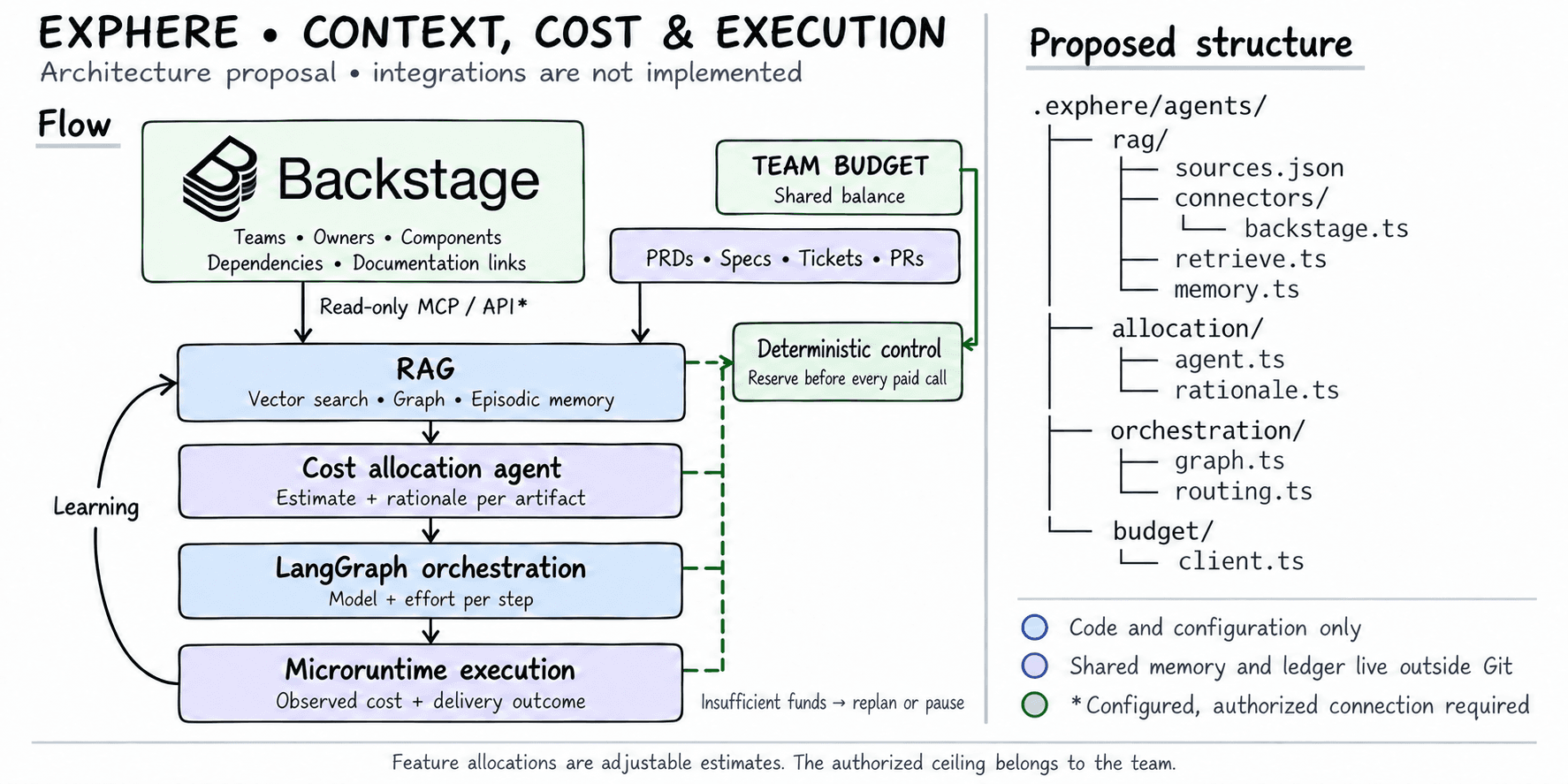
- Gather ownership and intent. A configured, authorized Backstage connection would provide component context. Artifact bodies come from their source.
- Assemble useful context. Retrieval would combine requirements, prior outcomes, and relevant evidence.
- Recommend investment. An allocator would propose work within the team’s budget and priorities.
- Coordinate execution. LangGraph would coordinate model and effort choices; deterministic controls would reserve funds before covered paid calls.
- Learn from results. Observed outcomes would return to memory for future decisions.
The Backstage connector, retrieval store, allocator, orchestrator, and financial ledger are not implemented. The integration is intended to complement an existing developer portal, not require its replacement.
Current workspace boundaries
| Location | Responsibility |
|---|---|
packages/ex/ | Private @exphere/ex: Go CLI, project-local bins, and bounded runtime lifecycle. |
packages/sdk/ | Private @exphere/sdk: CLI bridges and a TypeScript API that remains empty. |
packages/design/ | Generated CSS/JSON design tokens. |
packages/web/ | Shared ExphereShader React surface. |
apps/website/ | Next.js/Nextra introduction and documentation. |
.agents/features/ | Proposed capabilities and existing illustrations. |
.exphere/artifacts/ | Typed PRDs, specs, tickets, research, and design records. |
.exphere/workflow/ | Documentary SDD lifecycle and installed workflow skills. |
.exphere/harness/ | Shared policies and retained supporting material. |
Public-intent package metadata does not demonstrate registry publication. The Go CLI does not expose the former shell runtime implementation.
Thirteen feature proposals
The feature register groups the direction around explaining delivery, bounding consumption, planning with evidence, executing and recovering, and evaluating improvement. Each proposal has its own acceptance criteria, dependencies, and limitations.
Earlier factory sketch
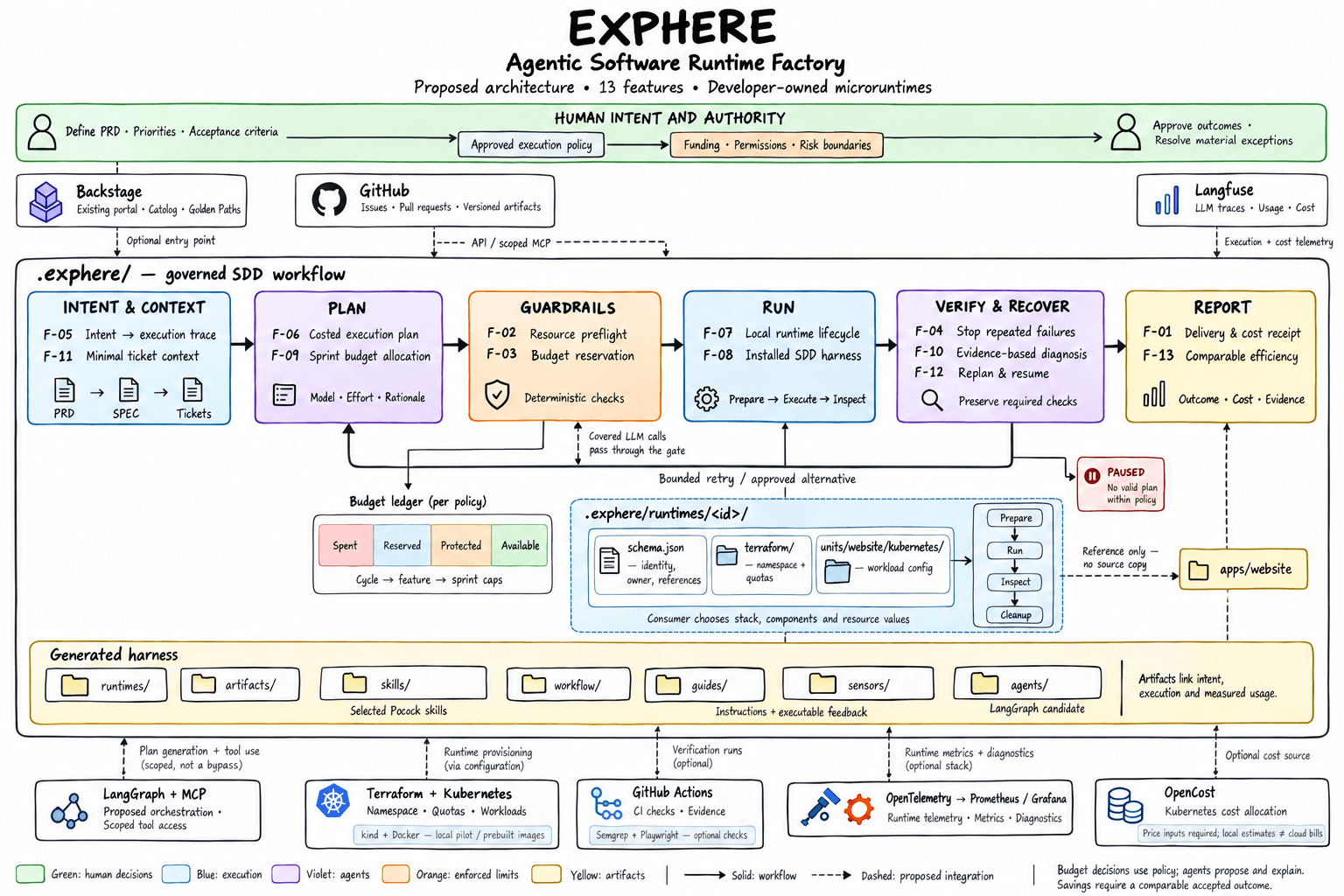
This earlier sketch illustrates the breadth of the proposed flow. Its cycle/feature/sprint-cap budget wording is superseded by the shared team budget model above. Neither image is a screenshot of running integrations.
See image provenance and third-party attribution , the design overview , and the local microruntime requirements .